Why Brevard Pools Turn Green, and What Recovery Involves
Green water usually has a short list of causes, and knowing them makes the next one easier to prevent.
October 21, 2026 · 4 min read
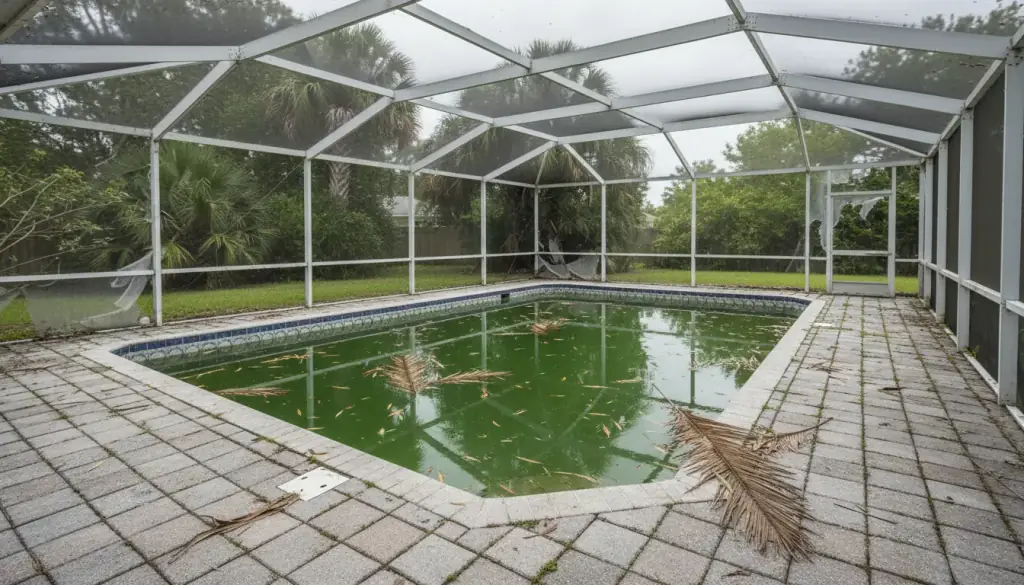
A pool can look fine on a Friday and look like a pond by the next Wednesday. If you own one in Brevard County, you've either seen it happen to a neighbor or lived it yourself. Green water isn't a mystery, and it doesn't mean you did something terrible. It's algae doing what algae does when the conditions line up, and in Florida the conditions line up more often than anyone would like.
Why Brevard pools turn so fast
Algae spores are always around. They ride in on wind, rain and leaves, and every pool gets a steady delivery. What keeps them from taking hold is enough sanitizer in the water to knock them back as they arrive. Green water means that protection slipped, and a few things about our climate make slipping easy.
Heat does two jobs at once. Strong sun and warm water use up chlorine faster, and algae grows faster in warm water. So the sanitizer drops at exactly the moment the algae is speeding up. A pool that held steady in March can get away from you in July.
Summer rain adds to it. A heavy afternoon storm puts a lot of water into the pool, and rainwater dilutes whatever chlorine was there. It also washes in dust, pollen and plant debris that algae feeds on. A screened enclosure helps, but wind-driven rain gets through a screen, and a pool without one takes the full dose.
Put those together with an ordinary lapse or two and you get a green pool. These are the usual causes:
- A pump timer that was shortened, reset after a power flicker, or left off, so the water isn't circulating long enough each day.
- Leaves, palm fronds and pollen piling up under the screen cage and in the skimmer baskets, then breaking down in the water.
- Chlorine that dropped during a run of storms while nobody was testing.
- A filter that's overdue for cleaning and can't clear the water as fast as the algae grows.
- A house that sat empty for a few weeks, which is common when owners travel or head north for the summer.
Why circulation and the screen cage matter
Moving water is harder for algae to settle in. When the pump runs its full schedule, water gets pulled through the skimmer and filter, and fresh sanitizer gets spread around the whole pool, including the corners and steps where water tends to sit still. Shorten that timer to save a little on the electric bill and you've created dead spots where algae gets started.
The screen cage keeps out the big stuff, and that's a real benefit. What gets through is fine pollen and small leaves, plus whatever collects along the bottom of the cage and drifts down after a storm. Organic material in the water uses up chlorine, so a pool that looks clean on top can still be quietly losing its sanitizer. That's one reason the skimmer and pump baskets deserve a regular look, even in an enclosed pool.
What a green pool recovery involves
Recovery isn't a single step. It starts with testing the water so the treatment fits the pool, since a pool that's lightly green needs different handling than one so dark you can't see the floor. From there, depending on the pool, the work can include an acid wash or a chlorine wash, a complete cleaning, and a hard look at the filter, which will have been working overtime. Native Pools of Brevard lists its green pool service as eliminating excessive algae and bacteria, using acid wash and chlorine wash methods along with a complete cleaning.
An acid wash uses diluted acid to take a thin layer off a plaster surface, which lifts algae stains and growth that regular brushing can't reach. It's done with care, because the surface underneath is sensitive. A chlorine wash leans on heavy sanitizing and a lot of brushing instead. Which one fits depends on the pool surface and how deep the problem goes, so it's worth having someone look at the pool in person before deciding.
After the heavy work, the water chemistry needs balancing and the filter needs cleaning again, because it will have caught a lot of dead algae. How long the whole thing takes depends on how far gone the pool was. A mildly green pool and a swamp are different jobs.
Why a green pool shouldn't wait
Standing water that isn't being sanitized is where mosquitoes breed, and mosquitoes can carry diseases that are a real concern in Florida. Eliminating mosquito disease dangers is part of the green pool service for that reason. Neglected pools are also something local code enforcement can fine owners over. The specifics vary by city and county and change over time, so check with yours, but it's a good reason not to let it ride.
The other reason is plain effort. A pool caught early might need a good brushing and a rebalance. A pool left for a month can need a full recovery. And once the water is clear again, a weekly routine of testing, brushing and filter checks is what keeps it that way.
If your pool has already turned, or you'd rather it never does, Native Pools of Brevard offers free estimates, a pool water evaluation and a chemical balance test, with a no obligation maintenance quote. Call (321) 446-6242 and ask John Sirounis to take a look.
Native Pools of Brevard, 321-446-6242
Call 321-446-6242More articles
What a Weekly Pool Service Visit Actually Covers
Knowing what belongs on the weekly checklist helps you judge any pool service, and shows why the visits matter in Brevard.
Reading Your Pool Water: Slime, Odor, Cloudiness and pH
Your pool tells you when something's off, and the signs show up well before the water turns green.